Showing posts with label Freedom of Religion. Show all posts

Saturday, August 04, 2007

Where did God tell the truth and where did the serpent lie?

Let's do a little analysis of Genesis chapters 2 and 3 and see if we can't ascertain where God told the truth and where the serpent lied.

We start with Genesis 2:8-9:
8 Now the LORD God had planted a garden in the east, in Eden; and there he put the man he had formed. 9 And the LORD God made all kinds of trees grow out of the ground—trees that were pleasing to the eye and good for food. In the middle of the garden were the tree of life and the tree of the knowledge of good and evil.
and Genesis 2:15-17:
15 The LORD God took the man and put him in the Garden of Eden to work it and take care of it. 16 And the LORD God commanded the man, "You are free to eat from any tree in the garden; 17 but you must not eat from the tree of the knowledge of good and evil, for when you eat of it you will surely die."
With that, the stage is set. God creates Adam, Eve, and the Garden of Eden. In the Garden of Eden he has 2 trees, the Tree of Life and the Tree of the Knowledge of Good and Evil. Of these two trees, he forbids them to eat from the second tree (the tree of knowledge of good and evil), but makes no mention of the first (the tree of life). He tells them that if they eat from the tree of the knowledge of good and evil, they will die.

With this God has created the first temptation, the first command and the first deception.

This brings us to Genesis 3.

First let's look at Genesis 3:1-5:
1 Now the serpent was more crafty than any of the wild animals the LORD God had made. He said to the woman, "Did God really say, 'You must not eat from any tree in the garden'?"

2 The woman said to the serpent, "We may eat fruit from the trees in the garden, 3 but God did say, 'You must not eat fruit from the tree that is in the middle of the garden, and you must not touch it, or you will die.' "

4 "You will not surely die," the serpent said to the woman. 5 "For God knows that when you eat of it your eyes will be opened, and you will be like God, knowing good and evil."
Pay close attention to what the serpent says here. He says that while God has told them they will die if they eat from the tree, and Eve affirms that if she touches the tree she will die, the serpent clarifies that she will actually not die, but instead gain the Knowledge of Good and Evil like God.

Which brings us to Genesis 3:6-7:
6 When the woman saw that the fruit of the tree was good for food and pleasing to the eye, and also desirable for gaining wisdom, she took some and ate it. She also gave some to her husband, who was with her, and he ate it. 7 Then the eyes of both of them were opened, and they realized they were naked; so they sewed fig leaves together and made coverings for themselves.
Here Eve, prompted by the desire of knowledge and wisdom planted in her by God, listens to the advice of the serpent who tells her that she will not die if she eats from the tree, but will instead gain God's knowledge. She eats from the tree, shares with Adam and they both gain the knowledge of their own nakedness and clothe themselves.

Which brings us to Genesis 3:8-10:
8 Then the man and his wife heard the sound of the LORD God as he was walking in the garden in the cool of the day, and they hid from the LORD God among the trees of the garden. 9 But the LORD God called to the man, "Where are you?"

10 He answered, "I heard you in the garden, and I was afraid because I was naked; so I hid."
Here we have God actually walking, as a physical being, through the Garden, where Adam and Eve hear him coming and hide themselves. God cannot find them and calls out to them, upon which they emerge and explain why they had hid themselves.

This brings up a few interesting points. First the question of why an omnipotent God would not be able to find them. Second, why was he physically strolling through the garden? We'll get to the latter point, and another related point, in a bit.

Next we have Genesis 3:11-13:
11 And he said, "Who told you that you were naked? Have you eaten from the tree that I commanded you not to eat from?"

12 The man said, "The woman you put here with me—she gave me some fruit from the tree, and I ate it."

13 Then the LORD God said to the woman, "What is this you have done?"
The woman said, "The serpent deceived me, and I ate."
Here God questions how they gained the knowledge of their nakedness and Eve places the blame on the serpent for deceiving her. (A bit humorous, given the context, as we'll see shortly.)

Upon hearing this, God proceeds to damn both them and the serpent for disobeying him, and in the process catching him in a lie.

Genesis 3:14-15:
14 So the LORD God said to the serpent, "Because you have done this,
"Cursed are you above all the livestock
and all the wild animals!
You will crawl on your belly
and you will eat dust
all the days of your life.

15 And I will put enmity
between you and the woman,
and between your offspring and hers;
he will crush your head,
and you will strike his heel."
We see that God curses the snake to be reviled for eternity and be the enemy of man to be crushed under foot etc.

Then God proceeds to curse Adam and Eve for their part in the discovery...

Genesis 3:16-19:
16 To the woman he said,
"I will greatly increase your pains in childbearing;
with pain you will give birth to children.
Your desire will be for your husband,
and he will rule over you."

17 To Adam he said, "Because you listened to your wife and ate from the tree about which I commanded you, 'You must not eat of it,'
"Cursed is the ground because of you;
through painful toil you will eat of it
all the days of your life.

18 It will produce thorns and thistles for you,
and you will eat the plants of the field.

19 By the sweat of your brow
you will eat your food
until you return to the ground,
since from it you were taken;
for dust you are
and to dust you will return."
Here he not only curses Adam and Eve and all their descendants for eternity to suffer in every aspect of lives through pain and toil, as an added bonus he makes sure to point out that Eve (and all women thereafter) will be subservient to her husband as the master who will rule over her.

And this brings us to the key verses that tie it all together...

Genesis 3:21-24:
21 The LORD God made garments of skin for Adam and his wife and clothed them. 22 And the LORD God said, "The man has now become like one of us, knowing good and evil. He must not be allowed to reach out his hand and take also from the tree of life and eat, and live forever." 23 So the LORD God banished him from the Garden of Eden to work the ground from which he had been taken. 24 After he drove the man out, he placed on the east side of the Garden of Eden cherubim and a flaming sword flashing back and forth to guard the way to the tree of life.
And there we have the clincher... God admits that instead of dieing, they did indeed gain his knowledge of good and evil just as the serpent said would happen, and that lest they eat from the other tree which he neglected to mention and become gods themselves, he makes sure to banish them from the garden and plant an angel with a flaming sword at the gate to make sure they can never get at that tree and gain the other half of what he has and become gods themselves.

So the question stands in its simplicity... Where did God tell the truth, and where did the serpent lie?


In case you missed it, notice that God specifically speaks of "one of us". Early Hebrew religion was polytheistic and anthropomorphized. The Gods were physical beings who strolled about the garden with Adam and Eve. They had human emotions and acted as humans, albeit with great knowledge, power and eternal life.

The particular God referred to in these chapters first creates Adam, then Eve, then tries to keep them from gaining his knowledge by threatening them with certain death if they eat from the tree of the knowledge of good and evil. He avoids mentioning the tree of life, as if they ate from that they would gain eternal life. The serpent then comes along and points out that God had lied, and that they would not die like he said, but gain his knowledge if they ate from it. When they ate from it, instead of dying like God had said, they did in fact gain his knowledge. God was enraged when the game was up and cursed the lot of them and all their progeny for eternity to lives of suffering, torment, enmity and death and then quickly cast them out before, by his own words, they could gain eternal life on top of the knowledge of the gods and become one of them (the gods).


A few points in closing. The Hebrew religion did not become a unified, monotheistic religion with a God that transcended this world until the time of Moses, when the Hebrews fled from Egypt. There are also a number of other glaring contradictions in the first two chapters of Genesis such as two conflicting stories of the creation and the more modernly understood errors of considering the sun and moon to be two of the same objects, and the stars something different from the sun. Or the fact that the light appeared before the objects, which were thought to be two different things, the sun and the stars, were created to give that light.

Let's address these points as well, just for thoroughness' sake.

In Genesis 1:6-10 we have God separating the waters into the ocean of the sky and the ocean of the Earth, which were believed to be as two oceans. He then further separates the ocean of the Earth from the land beneath it and creates the oceans and continents.
6 And God said, "Let there be an expanse between the waters to separate water from water." 7 So God made the expanse and separated the water under the expanse from the water above it. And it was so. 8 God called the expanse "sky." And there was evening, and there was morning—the second day.

9 And God said, "Let the water under the sky be gathered to one place, and let dry ground appear." And it was so. 10 God called the dry ground "land," and the gathered waters he called "seas." And God saw that it was good.
See Psalm 148:4 for another verse that backs up this stance:
4 Praise him, you highest heavens
and you waters above the skies.
The heavens were considered a type of physical dome that separated the oceans on earth from the oceans of the heavens. Upon this dome were the stars that moved fixed in their rotations.

Then we have Genesis 1:11-13:
11 Then God said, "Let the land produce vegetation: seed-bearing plants and trees on the land that bear fruit with seed in it, according to their various kinds." And it was so. 12 The land produced vegetation: plants bearing seed according to their kinds and trees bearing fruit with seed in it according to their kinds. And God saw that it was good. 13 And there was evening, and there was morning—the third day.
Here God first creates plant life, which relies on photosynthesis to survive, before he gets around to actually creating the Sun which they depend on for their nourishment. He also states that days are passing when there is not yet a Sun created to facilitate the passage of days. This belies the obvious lack of knowledge of photosynthesis, and a puzzling disregard for what had been known for millennia at this point as the cause of the passage of days, beyond the other glaring errors I'll address momentarily.

Which brings us to Genesis 1:14-19:
14 And God said, "Let there be lights in the expanse of the sky to separate the day from the night, and let them serve as signs to mark seasons and days and years, 15 and let them be lights in the expanse of the sky to give light on the earth." And it was so. 16 God made two great lights—the greater light to govern the day and the lesser light to govern the night. He also made the stars. 17 God set them in the expanse of the sky to give light on the earth, 18 to govern the day and the night, and to separate light from darkness. And God saw that it was good. 19 And there was evening, and there was morning—the fourth day.
Here we have God creating the Sun and the Moon as two like bodies that create the day and the night, after already pronouncing day and night previous to their creation, and then creating the stars as separate entities. He then specifically notes that due to the creation of these, there was evening and morning, the fourth day. Which specifically clarifies that the days spoken of in creation were the literal days as we know them. The rising and the setting of the sun and the traversal of the moon during the night.

First let's have a look at Genesis 1:11-13:
11 Then God said, "Let the land produce vegetation: seed-bearing plants and trees on the land that bear fruit with seed in it, according to their various kinds." And it was so. 12 The land produced vegetation: plants bearing seed according to their kinds and trees bearing fruit with seed in it according to their kinds. And God saw that it was good. 13 And there was evening, and there was morning—the third day.
Here all plant life is created on the third day, with Man not created until the sixth day.

Then, let us contrast that with Genesis 2:4-9:
4 This is the account of the heavens and the earth when they were created.
When the LORD God made the earth and the heavens- 5 and no shrub of the field had yet appeared on the earth and no plant of the field had yet sprung up, for the LORD God had not sent rain on the earth and there was no man to work the ground, 6 but streams came up from the earth and watered the whole surface of the ground- 7 the LORD God formed the man from the dust of the ground and breathed into his nostrils the breath of life, and the man became a living being.

8 Now the LORD God had planted a garden in the east, in Eden; and there he put the man he had formed. 9 And the LORD God made all kinds of trees grow out of the ground—trees that were pleasing to the eye and good for food. In the middle of the garden were the tree of life and the tree of the knowledge of good and evil.
This further clarifies that the biblical authors had no concept of photosynthesis, but instead believed in their primitive ignorance that plant life relied solely upon water for its nourishment. So by their reckoning, there was no problem with creating the plants before there was ever a Sun to provide light for photosynthesis.

Beyond that, if we look specifically at verses 4-7 above, we see that in this tale of the creation man is created before the plants. Whereas in the previous tale of creation, only one chapter prior, the plants were created a full 3 days prior to the creation of man.

Now as we move beyond these first contradictions and fallacies, we come to the first instances of things in which man, in his original state, should have had no interest, being devoid of knowledge and of worldly things...

Genesis 2:10-17:
10 A river watering the garden flowed from Eden; from there it was separated into four headwaters. 11 The name of the first is the Pishon; it winds through the entire land of Havilah, where there is gold. 12 (The gold of that land is good; aromatic resin and onyx are also there.) 13 The name of the second river is the Gihon; it winds through the entire land of Cush. 14 The name of the third river is the Tigris; it runs along the east side of Asshur. And the fourth river is the Euphrates.

15 The LORD God took the man and put him in the Garden of Eden to work it and take care of it. 16 And the LORD God commanded the man, "You are free to eat from any tree in the garden; 17 but you must not eat from the tree of the knowledge of good and evil, for when you eat of it you will surely die."
Here God extols the inherent values of the lands being replete with Gold and Onyx, although Man at this point is supposedly bereft of the knowledge of such material things. Then God explicitly claims the aforementioned curse of death upon eating of the fruit of the tree of the knowledge of good and evil.

This basically brings us full circle, without delving into even more issues such as the animals of creation being specifically the livestock (cattle, sheep, goats etc) of the contemporary biblical authors, as well as numerous other aspects that have been proven to be absolutely impossible as written in the bible.

Apologists will try to claim a variety of things to reconcile these biblical narrations with the reality we live in, but it takes very little effort indeed to relegate them to the inconsequential realm of primitive mythology where they belong.

A simple example is thus: "If all the supernatural claims of Christianity, and the requisite Hebrew religion, are nothing more than metaphors, then why should we ascribe any inherent supernatural power or godlike authority to a teacher who came along and contradicted the teachings of his own religion and created his own sect, and whose only authority comes from its explicit link to that prior Abrahamic God?"

We can go on at length, book by book, chapter by chapter, verse by verse and debunk this belief system as the conglomeration of shams that it is.

(I've been doing some further research into various aspects of early Christianity, its links to astrology, formation under Constantine, lack of any resurrection story for the first several centuries, lack of any virgin birth story for the first several centuries, lack of any contemporary mention of Jesus whatsoever for the first several centuries. It's rather easy to state at this point that the New Testament as we know it is a wholly fabricated and plagiarized collection of stories that retroactively created the Jesus Christ we know today. A person who never existed in reality, but was instead a creation of a vast array of authors over the centuries, pulling often times verbatim excerpts from other previous historical and religious texts.)

Never be afraid to question.

Thursday, August 02, 2007

In response to Conspiracy Theorists' concept of a literal and personal God granting them authority over government.

In an ongoing discussion/debate on another website, I felt compelled to leave the following comment. (This was partially in response to a comment by James Madison, and primarily in response to a comment by Uber Highwayman)
Oh man... this is getting out of hand.

For the record, I'm a devout atheist. And I find it a bit sad when people cannot differentiate from the natural laws, such as laid down by the Roman empire, and which our legal system is based on... and the so called "God's law", which in all actuality has very little to do with morality, even less to do with civil issues and is even in reality contradictory to true freedom in the natural sense.

Christianity teaches absolute obedience to authority, without question and without skepticism of contradictory evidence and falsehoods etc. This very same mindset lends itself to abuses by governments who use it to rally the people behind God's cause... "One nation, Under God", "In God We Trust" etc... if you don't believe in God, you're not a patriot. And that is used to group people into one mindset... one of obedience and "patriotism" under a moniker which in itself is divisive within its own people. Those very statements and mottoes serve to divide the people between believers and non-believers instead of acknowledging us as we were meant to be, individuals with inherent natural rights. Rights not granted by any particular God... but natural rights that transcend any particular religion's God's word on which rights you do and don't have.

The idea of "Divine Law" is the very same belief that allows the theocracies in the middle east to publicly execute people found "guilty" of homosexuality, sex before marriage, and any number of other things that might offend the particular deity of some of its people... when no rational "crime" has been committed. In the natural world, an adult has the right to sleep with another adult, in or out of wedlock, should they so choose. You don't have to personally approve of it, but they have the right as human beings to do so... and unless that robs you of your property or does you personal injury, you have no right to deprive them of their life, liberty or property for merely offending your personal moral beliefs.

E Pluribus Unum. Out of Many, (come) One. A celebration of the diversity of our culture, the diversity of our beliefs, the diversity of our ethnic roots... and through that a celebration of our unity as Americans. Stronger as a result of that diversity, not in spite of it.

The fact that our founding fathers were wise enough to understand that strength and celebrate it... and take measures to ensure the freedom of the people to believe as they wished, as human beings with inherent natural rights... that is something that we should take heed of.

God isn't going to grant you any benefit in a battle. You have to do that for yourself. The mere fact that you imply that your idea of a God somehow grants you some authority greater than that of another man who might believe in a different God, inherently impedes upon that man's freedom.

And to believe in a God that forbids you to believe in anything he does not approve of, regardless of rational merit... a God who commands you to kill people of different beliefs or sexual orientations, in spite of no rational crime being committed... a God who names himself a Jealous God that commands you to obey and never to question, in spite of mountains of evidence to the contrary... that God is the epitome of our modern government. A Genocidal egomaniac responsible for mass genocide of people who committed no crime other than believing in a different God, or no God, or in believing they had the very same natural rights that you do... to live, govern themselves and choose their own paths as individuals or as a society.

I dislike entertaining ridiculous conspiracy theories, so I'm loathe to start debunking the ridiculous nature of many of Madison's claims... much less the fact that he presumes to use the name of one of the founding fathers as though he in any way resembles such a great man.

But I feel it is important to remove the idea of "natural law" from that of some divinely derived authority. Am I to have no inherent liberties as an atheist? Am I somehow not a patriot or exempt from the same freedoms afforded to the faithful?

No. The founding fathers understood this and wisely exempted religion from any official place in government. A man or woman are free to hold their own beliefs and free to have them serve as a moral compass... but those beliefs fall short when they infringe upon the natural liberties of all men, regardless of their beliefs in much the same way that even if the government believes it has a legal right to deprive you of your property, you have a natural right not to be extorted, threatened at gunpoint and made a slave of a relatively small group of people who claim that authority over you, regardless of their justifications. And no God is going to come down and change that for you. You must stand upon the same principles our founding fathers did in their various backgrounds and beliefs and come together in an understanding of the fundamental principles of liberty and freedom that predated your Abrahamic God by millennia and strive to return man to his natural state.

As Einstein said:
The more a man is imbued with the ordered regularity of all events the firmer becomes his conviction that there is no room left by the side of this ordered regularity for causes of a different nature. For him neither the rule of human nor the rule of divine will exists as an independent cause of natural events. To be sure, the doctrine of a personal God interfering with natural events could never be refuted, in the real sense, by science, for this doctrine can always take refuge in those domains in which scientific knowledge has not yet been able to set foot.

But I am convinced that such behavior on the part of representatives of religion would not only be unworthy but also fatal. For a doctrine which is to maintain itself not in clear light but only in the dark, will of necessity lose its effect on mankind, with incalculable harm to human progress. In their struggle for the ethical good, teachers of religion must have the stature to give up the doctrine of a personal God, that is, give up that source of fear and hope which in the past placed such vast power in the hands of priests. In their labors they will have to avail themselves of those forces which are capable of cultivating the Good, the True, and the Beautiful in humanity itself. This is, to be sure, a more difficult but an incomparably more worthy task...
--Albert Einstein
In losing focus on the fundamental reality of the matter at hand, you place power back in the hands of the authority figures who in the same manner as religion, demand obedience without question. Authority over you and subservience by you in the face of violations of your natural right to true freedom in the face of contradictory or fallacious evidence to the contrary of their claims.

Cogito, percipio.
I've been having other related religious discussions on another forum as well in the past few days and seem to be reaching another point of frustration at which I feel compelled to speak out.

http://en.wikipedia.org/wiki/Natural_law

Tuesday, July 31, 2007

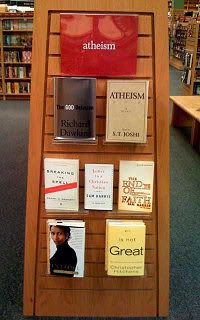
Congratulations and Thanks to Borders Book Stores.

Atheism End Cap at BordersAn Atheism End Cap at another Borders book store
http://scienceblogs.com/pharyngula/2007/07/the_bookstores_have_noticed_us.php

Borders book stores have finally added an "Atheism" section to many of their stores. Let's just hope that Barnes&Noble will follow suit and start acknowledging the rest of us.

One thing I've noticed is that it seems to be only an "End Cap" so far, but it's definitely a step in the right direction.

Tuesday, July 03, 2007

Separation of Church and State

I've covered this issue in various ways in past posts, but felt I should write a clean, coherent post on the subject to hopefully clarify the issue.

First I'll include some posts I wrote on another forum, and then follow that up with some further explanation.
I ran across this article around 5 years ago, written by Rev. Charles Henderson. To give you an idea who he is, I've included an excerpt from his bio on his website "GodWeb".

It's refreshing to see a Christian who understands the fundamental importance of a separation between Church and State.

Here's the bio excerpt:
Who is Charles Henderson?

The Rev. Charles P. Henderson, a graduate of Princeton University and Union Theological Seminary, is a Presbyterian minister. He has led churches in New York, New Jersey and Connecticut and has served as a chaplain at Princeton. He is the author of numerous articles and books including God and Science (John Knox / Westminster Press, 1986). He has taught and lectured at Princeton, Columbia, Yale Divinity School, Union Seminary, Harvard Divinity School, and others. He is Executive Director of the Association for Religion and Intellectual Life, an interfaith organization that publishes CrossCurrents, an academic quarterly and is President of the Society for the Arts, Religion and Contemporary Culture. Rev. Henderson is a founding member of CIE/ the Consultation on Interfaith Education.

He lives in New York City with his spouse, The Rev. Katharine Rhodes Henderson, Executive Vice President of Auburn Theological Seminary. The Hendersons have three children and two grand children. When not working on the projects mentioned above, Charles Henderson may be out sailing in the waters of New York harbor or beyond.
And here is the article itself in full:
A Wall That Should Not Fall
While some propose tearing it down, the wall separating church and state must stand

This is not the first period in our history when there has been a widespread debate over the posting of the Ten Commandments on school house walls. In 1844 there were riots in the streets of Philadelphia over the question of which version of the Ten Commandments would be so posted. In these riots six people were killed. Note that the 19th Century debate was not whether the Commandments should appear on school house walls, but only which version. But religious passions ran so strong around the issue that blood flowed in the city's streets.

I mention this obscure event in American history because it illustrates a problem I have with President Bush's effort to provide direct federal support to faith based organizations. When asked recently what the federal government could do to control the allegedly harmful effects of popular media: music, movies, and such, that appeared to be "bringing our country down," Bush again referred to his proposals to fund "character education" programs in the public schools. These new programs would not be run by the schools themselves but by private "faith-based" organizations, churches, para-churches, and the like.
You bet there's things the government can do. I would greatly expand character education funding. I think that after-school money ought to be available for faith-based programs and charitable programs that exist because somebody has heard the call to love a neighbor like you'd like to be loved yourself. -- George W. Bush October 17, 2000
During last year's presidential campaign there was little debate about all this because Al Gore also announced his support for similar initiatives. Indeed, the extent to which religion factored in the presidential campaign is only one part of a much larger story. For several years now, in various ways, we have witnessed a major re-alignment in thinking in the highest reaches of power about the relationship between religion and public life, between church and state. Federal funding for character education programs in the schools and "faith based" poverty programs that would replace traditional welfare are only the tip of the iceberg.

Indeed, some suggest that if the last great event of the twentieth century was the fall of the Berlin wall and the emergence of a new world order in which capitalism prevails, the first great event of the twenty-first century may be the fall of the wall separating church and state in the United States and the emergence of a new "politics of redemption" in which the line between private faith and partisan politics disappears. Some welcome this trend, seeing it as the key to our future; others are deeply alarmed. And perhaps the most interesting thing about this discussion is that traditional differences between liberals and conservatives, Republicans and Democrats, born again Christians and others less clear about their religious commitments are breaking down. New alliances are being forged, and old friendships tested.

In a recent article in the New York Review of Books, Joan Didion traces the roots of what George Bush has referred to as "compassionate conservatism." While the term is open to many possible interpretations, Didion credits (blames?) Marvin Olasky, a journalism professor at the University of Texas, who has been a Bush advisor since 1993, with doing more than anyone to influence the candidate's thinking on the topic. Olasky is a born-again, evangelical Christian and author of a highly influential book, The Tragedy of American Compassion. Published in 1992, the book so impressed William J. Bennett when he read it in 1994 that he gave it to Newt Gingrich as a Christmas present; Gingrich recommended it as required reading for all Republican members of Congress. Olasky has further refined his thinking in this year's Compassionate Conservatism, which is nothing less than a manifesto for the transformation of political life in America. Candidate Bush contributed a foreward for Olasky's latest book. In it he writes: "Marvin offers not just a blueprint for government, but also an inspiring picture of the great resources of decency, caring, and commitment to one another that Americans share."

In these books Olasky spells out the critical role that "faith based" organizations will play in the politics of redemption. He also makes an important distinction between newer "faith based" organizations and traditional ones like Church World Service or Catholic Charities that have long worked hand in hand with government. Writes Didion:
This use of "faith-based" is artful, and worth study. Goodwill was founded by a Methodist minister and run during its early years out of the Morgan Memorial Chapel in Boston, which would seem to qualify it as based in faith, although not, in the sense that Olasky apparently construes the phrase, as "faith-based." "Faith-based," then, is, as Olasky uses it, a phrase with a special meaning, a code phrase, employed to suggest that certain worthy organizations have been prevented from receiving government funding solely by virtue of their religious affiliation. This is misleading, since "religiously affiliated" organizations can and do receive such funding. The organizations that have not are those deemed "pervasively sectarian," a judgment based on the extent to which they proselytize, or make religious worship or instruction a condition of receiving aid. This, the Supreme Court has to date maintained, would violate the establishment clause of the First Amendment.
Olasky believes that the very concept of a "wall" separating church and state is a fiction, a myth that should be exposed as such. Writes Olasky, "There's nothing about 'separation of church and state' in the Constitution or the First Amendment. That was Thomas Jefferson's personal expression in a letter written over a decade after the amendment was adopted.... The founding fathers would be aghast at court rulings that make our part of the world safe for moral anarchy."

Which brings me back to 1844 and those Philadelphia riots. In the third debate George Bush repeated over and over again that the problem with "Washington" is that people tend to be divided along partisan lines. Democrats and Republicans engage in too much " bitterness and bickering," and thus can't get anything significant accomplished. Wouldn't it be wonderful if, rather than dividing along partisan political lines, our leaders could unite around basic precepts such as the Golden Rule, which in the George Bush version declares that everyone should "love their neighbors as they'd like to be loved themselves."
In every instance where my administration sees a responsibility to help people, we look first to faith based organizations, charities and community groups that have shown their ability to save and change lives. ... We will change the laws and regulations that hamper the cooperation of government with private institutions.
-- George W. Bush July 22, 1999
Generalities like this make "compassionate conservatism" sound like something that all Americans could join in supporting, wholeheartedly. The problem is that just as there are differences with regard to the Ten Commandments that were so strongly felt that they caused riots in the streets of Philadelphia, there are also grave differences with regard to the Golden Rule and what it requires. While some believe that the Golden Rule (and the command to "love thy neighbor" with which George Bush confuses it) requires that Christians and Jews should learn to live together peacefully, respecting each other's beliefs, others passionately believe that neighborly love requires that Christians inform their Jewish neighbors that they are in mortal danger of facing an eternity in hell if they do not convert. Likewise, while some believe that the Golden Rule requires that gay and lesbian persons be treated as equals in every possible way, others believe with equal passion that the Golden Rule requires that one should inform gay and lesbian persons that they are living a life of sin. In fact, religious communities all across America are deeply divided in their understanding of what the Golden Rule requires with respect to issues like abortion, the relationship between the genders, capital punishment, gun control, school vouchers, or homosexual unions. Indeed, the courts of our churches are as deeply divided over many of these issues as is Washington. If you want to see examples of the partisan "bitterness and bickering" that George Bush finds is the heart of the problem in Washington, all you have to do is attend the national meeting of any of the major religious groups in America. Few of these meetings take place inside the Beltway.

If Bush advisor Marvin Olasky believes that Supreme Court decisions upholding the wall of separation between church and state have served no better purpose than to make room for "moral anarchy," I have news for him. The way out of moral anarchy cannot be found by turning our school systems, our poverty programs, or our public life generally over to the leadership of "faith based" organizations that are themselves deeply divided over basic questions about what true "faith" is. Religious passions and religious differences are the stuff that wars are made of. The founders of our republic knew this very well. That is why they erected the wall that was designed to separate religious passion from the more rational deliberations which they believed would contribute to good government. The founders of our republic got it right. Religious passions are important; they are the motivating force of my own life. They are also powerful and potentially dangerous, as the victims of religious persecution around the world can testify. We dismantle the wall the separates these passions from the seat of government at our own grave peril. This is one wall that should not fall.
The emphasis at the end is mine.
scourge99 said: Many people are very confused on what this means. The key word here is "establishment". The forefathers did not want a national church that existed in some European countries. So basically the US is not allowed to have a nationally recognized church or give preferential support to any religion.
Gee, expressly making it a law to have "In God We Trust" and "Under God" as parts of our government, pledge of allegiance, national motto and on our money etc... wouldn't happen to be preferential support for a religion would it?

When my government makes the express statement that to be an American is to believe in God, they are falsely speaking for me. They are asserting that I believe in God when I do not. They are clearly expressly supporting religion, expressly Christianity.

This quite clearly goes against the wishes of the founding fathers whose deliberations on this topic are available to understand the context in which they wrote it, including Thomas Jefferson, who authored the Declaration of Independence and who was influential in the creation of the Constitution and drafted the Virginia Statute for Religious Freedom. He wrote "The legitimate powers of government extend to such acts only as are injurious to others. But it does me no injury for my neighbor to say there are twenty gods or no God. It neither picks my pocket nor breaks my leg." as well as making it clear that the government should not act to speak for any man by asserting for that man a believe in God.

While the root of the movement was to prevent the establishment of a church in relation to what had happened in England, through deliberation it was clearly deemed that to take any particular religious stance would necessarily diminish the equality of any other religious stance and thereby infringe upon the natural rights of man.
scourge99 said: There is no law or amendment that says, "Don't make laws just because your religion thinks it knows the only moral truth." My point is its scary to think that the US could become similar to a theocracy. The US may not be allowed to recognize a national church but it could recognize a bunch of laws stemming from a particular religion. Is there any way to circumvent this from happening?

However, on the flip side, if I am extremely religious, I believe my religion has the only answers, and in many cases, I would believe that others should follow my religion so they are "saved." So why shouldn't I attempt to have laws passed to have you "saved" if thats the will of the majority?

Is there some middle ground?
I think that was something important about the constitution and many of the documents involved in its creation, which are taken into account when interpreting constitutional rights. Our rights are not limited solely to what is spelled out explicitly in the constitution and bill of rights etc. It is not meant to imply that if something is not listed there, that you do not also still retain such other rights. It is more to cover simply a few of the most important as well as set some specific limitations and guidelines for the Government etc.

This is one of the reasons why so many supreme court decisions have still found in favor of "separation of church and state" because of the logical conclusions based on the full body of evidence etc.
I think some other important things to note are that the founding fathers had not only seen religious persecution in other countries, but had also seen it here in the United States before its inception with the infighting and persecution of the Puritans towards other Puritans and other Christians of differing beliefs, over differences of interpretation, or of the accusations of witchcraft or heresy etc.

They understood the idea that it was wrong to force another man to believe in your religion, and that by establishing a state religion, you effectively diminished the rights of any other religion that was not the favored state religion. That man had an inherent right to choose his beliefs for himself and that the role of the government was to stand on a neutral, secular ground in its laws to protect all religious beliefs equally. When a government takes a specific stand on the side of one particular religious belief, it inherently diminishes the protection and rights of all other religious beliefs.

In short, the government is establishing a state religion when it expressly states that all Americans believe in and trust in a Christian God. When they change the motto from the unofficial motto of "E pluribus Unum" (Out of many, [come] one.) to the official motto of "In God We Trust", they make the clear move from celebrating the diversity of ethnicities, beliefs, cultures etc of its constituents to the stance of labeling all citizens as Christians who believe and trust in God. Effectively labeling us a Christian nation, in spite of historical facts to the contrary. Then they officially add this motto to our paper currency, which is the only legal tender for all debts, public and private as a citizen. Then they add "under God" to the pledge of allegiance, requiring all citizens who wish to pledge allegiance to the United States, to pledge allegiance to it as a Christian nation, espousing a Christian doctrine.

I fail to see how people cannot grasp how this inherently diminishes the rights of people of different beliefs or non-believers. When we clearly see such quotes from George W. Bush himself as
Sherman: What will you do to win the votes of the Americans who are atheists?

Bush: I guess I'm pretty weak in the atheist community. Faith in God is important to me.

Sherman: Surely you recognize the equal citizenship and patriotism of Americans who are atheists?

Bush: No, I don't know that atheists should be considered as citizens, nor should they be considered patriots. This is one nation under God.

Sherman (somewhat taken aback): Do you support as a sound constitutional principle the separation of state and church?

Bush: Yes, I support the separation of church and state. I'm just not very high on atheists.
This sentiment is echoed throughout the government and in turn throughout the citizenry. Atheists are considered the least trusted minority group in America on the basis of race, ethnicity, religious beliefs, gender and sexuality.

To not believe in God is to not be a patriot, to not be a true citizen of this Christian nation.

Time and again we hear the phrase "This is a Christian nation." or more specifically "This nation was founded as a Christian nation." While the former may sadly be true today, this nation was not founded as a Christian nation. This nation was founded by men of varying beliefs with the intention of preserving a freedom for its people to believe or not believe in the religion of their choice without reprisal, ill treatment or oppression. Whether they used the moral principles of their personal religious believes as guides in their decision making or not, and we know that most obviously did as an inherent part of who they were, is irrelevant.

The Separation of Church and State is not meant to oppress Christianity, or any other belief for that matter, but to instead preserve the rights of the citizens to believe in Christianity or any other religion or lack thereof by maintaining a neutral stance in its role and thus protect all beliefs equally. Taking a specifically Christian stance, requiring a pledge to that expressly Christian nation, inherently diminishes the rights of all other religious beliefs. It implies that to not believe in God is to not be an American because all Americans believe in and trust in God.
"Congress shall make no law respecting an establishment of religion, or prohibiting the free exercise thereof;..."
— from the First Amendment to the U.S. Constitution
"... no religious Test shall ever be required as a Qualification to any Office or public Trust under the United States."
— from Article VI of the U.S. Constitution
"The Government of the United States is not in any sense founded on the Christian religion."
— from The Treaty of Tripoli, written during the administration of President George Washington, signed by President John Adams and unanimously approved by the Senate in 1797. (And in case you wanted to argue this point, the text that was signed by President Adams and reviewed and approved by the Senate did include that phrase.)