I've covered this issue in various ways in past posts, but felt I should write a clean, coherent post on the subject to hopefully clarify the issue.
First I'll include some posts I wrote on another forum, and then follow that up with some further explanation.
I ran across this article around 5 years ago, written by Rev. Charles Henderson. To give you an idea who he is, I've included an excerpt from his bio on his website "GodWeb".
It's refreshing to see a Christian who understands the fundamental importance of a separation between Church and State.
Here's the bio excerpt:Who is Charles Henderson?
The Rev. Charles P. Henderson, a graduate of Princeton University and Union Theological Seminary, is a Presbyterian minister. He has led churches in New York, New Jersey and Connecticut and has served as a chaplain at Princeton. He is the author of numerous articles and books including God and Science (John Knox / Westminster Press, 1986). He has taught and lectured at Princeton, Columbia, Yale Divinity School, Union Seminary, Harvard Divinity School, and others. He is Executive Director of the Association for Religion and Intellectual Life, an interfaith organization that publishes CrossCurrents, an academic quarterly and is President of the Society for the Arts, Religion and Contemporary Culture. Rev. Henderson is a founding member of CIE/ the Consultation on Interfaith Education.
He lives in New York City with his spouse, The Rev. Katharine Rhodes Henderson, Executive Vice President of Auburn Theological Seminary. The Hendersons have three children and two grand children. When not working on the projects mentioned above, Charles Henderson may be out sailing in the waters of New York harbor or beyond.
And here is the article itself in full:A Wall That Should Not Fall
While some propose tearing it down, the wall separating church and state must stand
This is not the first period in our history when there has been a widespread debate over the posting of the Ten Commandments on school house walls. In 1844 there were riots in the streets of Philadelphia over the question of which version of the Ten Commandments would be so posted. In these riots six people were killed. Note that the 19th Century debate was not whether the Commandments should appear on school house walls, but only which version. But religious passions ran so strong around the issue that blood flowed in the city's streets.
I mention this obscure event in American history because it illustrates a problem I have with President Bush's effort to provide direct federal support to faith based organizations. When asked recently what the federal government could do to control the allegedly harmful effects of popular media: music, movies, and such, that appeared to be "bringing our country down," Bush again referred to his proposals to fund "character education" programs in the public schools. These new programs would not be run by the schools themselves but by private "faith-based" organizations, churches, para-churches, and the like. You bet there's things the government can do. I would greatly expand character education funding. I think that after-school money ought to be available for faith-based programs and charitable programs that exist because somebody has heard the call to love a neighbor like you'd like to be loved yourself. -- George W. Bush October 17, 2000
During last year's presidential campaign there was little debate about all this because Al Gore also announced his support for similar initiatives. Indeed, the extent to which religion factored in the presidential campaign is only one part of a much larger story. For several years now, in various ways, we have witnessed a major re-alignment in thinking in the highest reaches of power about the relationship between religion and public life, between church and state. Federal funding for character education programs in the schools and "faith based" poverty programs that would replace traditional welfare are only the tip of the iceberg.
Indeed, some suggest that if the last great event of the twentieth century was the fall of the Berlin wall and the emergence of a new world order in which capitalism prevails, the first great event of the twenty-first century may be the fall of the wall separating church and state in the United States and the emergence of a new "politics of redemption" in which the line between private faith and partisan politics disappears. Some welcome this trend, seeing it as the key to our future; others are deeply alarmed. And perhaps the most interesting thing about this discussion is that traditional differences between liberals and conservatives, Republicans and Democrats, born again Christians and others less clear about their religious commitments are breaking down. New alliances are being forged, and old friendships tested.
In a recent article in the New York Review of Books, Joan Didion traces the roots of what George Bush has referred to as "compassionate conservatism." While the term is open to many possible interpretations, Didion credits (blames?) Marvin Olasky, a journalism professor at the University of Texas, who has been a Bush advisor since 1993, with doing more than anyone to influence the candidate's thinking on the topic. Olasky is a born-again, evangelical Christian and author of a highly influential book, The Tragedy of American Compassion. Published in 1992, the book so impressed William J. Bennett when he read it in 1994 that he gave it to Newt Gingrich as a Christmas present; Gingrich recommended it as required reading for all Republican members of Congress. Olasky has further refined his thinking in this year's Compassionate Conservatism, which is nothing less than a manifesto for the transformation of political life in America. Candidate Bush contributed a foreward for Olasky's latest book. In it he writes: "Marvin offers not just a blueprint for government, but also an inspiring picture of the great resources of decency, caring, and commitment to one another that Americans share."
In these books Olasky spells out the critical role that "faith based" organizations will play in the politics of redemption. He also makes an important distinction between newer "faith based" organizations and traditional ones like Church World Service or Catholic Charities that have long worked hand in hand with government. Writes Didion:This use of "faith-based" is artful, and worth study. Goodwill was founded by a Methodist minister and run during its early years out of the Morgan Memorial Chapel in Boston, which would seem to qualify it as based in faith, although not, in the sense that Olasky apparently construes the phrase, as "faith-based." "Faith-based," then, is, as Olasky uses it, a phrase with a special meaning, a code phrase, employed to suggest that certain worthy organizations have been prevented from receiving government funding solely by virtue of their religious affiliation. This is misleading, since "religiously affiliated" organizations can and do receive such funding. The organizations that have not are those deemed "pervasively sectarian," a judgment based on the extent to which they proselytize, or make religious worship or instruction a condition of receiving aid. This, the Supreme Court has to date maintained, would violate the establishment clause of the First Amendment.
Olasky believes that the very concept of a "wall" separating church and state is a fiction, a myth that should be exposed as such. Writes Olasky, "There's nothing about 'separation of church and state' in the Constitution or the First Amendment. That was Thomas Jefferson's personal expression in a letter written over a decade after the amendment was adopted.... The founding fathers would be aghast at court rulings that make our part of the world safe for moral anarchy."
Which brings me back to 1844 and those Philadelphia riots. In the third debate George Bush repeated over and over again that the problem with "Washington" is that people tend to be divided along partisan lines. Democrats and Republicans engage in too much " bitterness and bickering," and thus can't get anything significant accomplished. Wouldn't it be wonderful if, rather than dividing along partisan political lines, our leaders could unite around basic precepts such as the Golden Rule, which in the George Bush version declares that everyone should "love their neighbors as they'd like to be loved themselves."In every instance where my administration sees a responsibility to help people, we look first to faith based organizations, charities and community groups that have shown their ability to save and change lives. ... We will change the laws and regulations that hamper the cooperation of government with private institutions.
-- George W. Bush July 22, 1999
Generalities like this make "compassionate conservatism" sound like something that all Americans could join in supporting, wholeheartedly. The problem is that just as there are differences with regard to the Ten Commandments that were so strongly felt that they caused riots in the streets of Philadelphia, there are also grave differences with regard to the Golden Rule and what it requires. While some believe that the Golden Rule (and the command to "love thy neighbor" with which George Bush confuses it) requires that Christians and Jews should learn to live together peacefully, respecting each other's beliefs, others passionately believe that neighborly love requires that Christians inform their Jewish neighbors that they are in mortal danger of facing an eternity in hell if they do not convert. Likewise, while some believe that the Golden Rule requires that gay and lesbian persons be treated as equals in every possible way, others believe with equal passion that the Golden Rule requires that one should inform gay and lesbian persons that they are living a life of sin. In fact, religious communities all across America are deeply divided in their understanding of what the Golden Rule requires with respect to issues like abortion, the relationship between the genders, capital punishment, gun control, school vouchers, or homosexual unions. Indeed, the courts of our churches are as deeply divided over many of these issues as is Washington. If you want to see examples of the partisan "bitterness and bickering" that George Bush finds is the heart of the problem in Washington, all you have to do is attend the national meeting of any of the major religious groups in America. Few of these meetings take place inside the Beltway.
If Bush advisor Marvin Olasky believes that Supreme Court decisions upholding the wall of separation between church and state have served no better purpose than to make room for "moral anarchy," I have news for him. The way out of moral anarchy cannot be found by turning our school systems, our poverty programs, or our public life generally over to the leadership of "faith based" organizations that are themselves deeply divided over basic questions about what true "faith" is. Religious passions and religious differences are the stuff that wars are made of. The founders of our republic knew this very well. That is why they erected the wall that was designed to separate religious passion from the more rational deliberations which they believed would contribute to good government. The founders of our republic got it right. Religious passions are important; they are the motivating force of my own life. They are also powerful and potentially dangerous, as the victims of religious persecution around the world can testify. We dismantle the wall the separates these passions from the seat of government at our own grave peril. This is one wall that should not fall.
The emphasis at the end is mine.
scourge99 said: Many people are very confused on what this means. The key word here is "establishment". The forefathers did not want a national church that existed in some European countries. So basically the US is not allowed to have a nationally recognized church or give preferential support to any religion.
Gee, expressly making it a law to have "In God We Trust" and "Under God" as parts of our government, pledge of allegiance, national motto and on our money etc... wouldn't happen to be preferential support for a religion would it?
When my government makes the express statement that to be an American is to believe in God, they are falsely speaking for me. They are asserting that I believe in God when I do not. They are clearly expressly supporting religion, expressly Christianity.
This quite clearly goes against the wishes of the founding fathers whose deliberations on this topic are available to understand the context in which they wrote it, including Thomas Jefferson, who authored the Declaration of Independence and who was influential in the creation of the Constitution and drafted the Virginia Statute for Religious Freedom. He wrote "The legitimate powers of government extend to such acts only as are injurious to others. But it does me no injury for my neighbor to say there are twenty gods or no God. It neither picks my pocket nor breaks my leg." as well as making it clear that the government should not act to speak for any man by asserting for that man a believe in God.
While the root of the movement was to prevent the establishment of a church in relation to what had happened in England, through deliberation it was clearly deemed that to take any particular religious stance would necessarily diminish the equality of any other religious stance and thereby infringe upon the natural rights of man.
scourge99 said: There is no law or amendment that says, "Don't make laws just because your religion thinks it knows the only moral truth." My point is its scary to think that the US could become similar to a theocracy. The US may not be allowed to recognize a national church but it could recognize a bunch of laws stemming from a particular religion. Is there any way to circumvent this from happening?
However, on the flip side, if I am extremely religious, I believe my religion has the only answers, and in many cases, I would believe that others should follow my religion so they are "saved." So why shouldn't I attempt to have laws passed to have you "saved" if thats the will of the majority?
Is there some middle ground?
I think that was something important about the constitution and many of the documents involved in its creation, which are taken into account when interpreting constitutional rights. Our rights are not limited solely to what is spelled out explicitly in the constitution and bill of rights etc. It is not meant to imply that if something is not listed there, that you do not also still retain such other rights. It is more to cover simply a few of the most important as well as set some specific limitations and guidelines for the Government etc.
This is one of the reasons why so many supreme court decisions have still found in favor of "separation of church and state" because of the logical conclusions based on the full body of evidence etc.
I think some other important things to note are that the founding fathers had not only seen religious persecution in other countries, but had also seen it here in the United States before its inception with the infighting and persecution of the Puritans towards other Puritans and other Christians of differing beliefs, over differences of interpretation, or of the accusations of witchcraft or heresy etc.
They understood the idea that it was wrong to force another man to believe in your religion, and that by establishing a state religion, you effectively diminished the rights of any other religion that was not the favored state religion. That man had an inherent right to choose his beliefs for himself and that the role of the government was to stand on a neutral, secular ground in its laws to protect all religious beliefs equally. When a government takes a specific stand on the side of one particular religious belief, it inherently diminishes the protection and rights of all other religious beliefs.
In short, the government is establishing a state religion when it expressly states that all Americans believe in and trust in a Christian God. When they change the motto from the unofficial motto of "E pluribus Unum" (Out of many, [come] one.) to the official motto of "In God We Trust", they make the clear move from celebrating the diversity of ethnicities, beliefs, cultures etc of its constituents to the stance of labeling all citizens as Christians who believe and trust in God. Effectively labeling us a Christian nation, in spite of historical facts to the contrary. Then they officially add this motto to our paper currency, which is the only legal tender for all debts, public and private as a citizen. Then they add "under God" to the pledge of allegiance, requiring all citizens who wish to pledge allegiance to the United States, to pledge allegiance to it as a Christian nation, espousing a Christian doctrine.
I fail to see how people cannot grasp how this inherently diminishes the rights of people of different beliefs or non-believers. When we clearly see such quotes from George W. Bush himself as
Sherman: What will you do to win the votes of the Americans who are atheists?
Bush: I guess I'm pretty weak in the atheist community. Faith in God is important to me.
Sherman: Surely you recognize the equal citizenship and patriotism of Americans who are atheists?
Bush: No, I don't know that atheists should be considered as citizens, nor should they be considered patriots. This is one nation under God.
Sherman (somewhat taken aback): Do you support as a sound constitutional principle the separation of state and church?
Bush: Yes, I support the separation of church and state. I'm just not very high on atheists.
This sentiment is echoed throughout the government and in turn throughout the citizenry. Atheists are considered the least trusted minority group in America on the basis of race, ethnicity, religious beliefs, gender and sexuality.
To not believe in God is to not be a patriot, to not be a true citizen of this Christian nation.
Time and again we hear the phrase "This is a Christian nation." or more specifically "This nation was founded as a Christian nation." While the former may sadly be true today, this nation was
not founded as a Christian nation. This nation was founded by men of varying beliefs with the intention of preserving a freedom for its people to believe or not believe in the religion of their choice without reprisal, ill treatment or oppression. Whether they used the moral principles of their personal religious believes as guides in their decision making or not, and we know that most obviously did as an inherent part of who they were, is irrelevant.
The Separation of Church and State is not meant to oppress Christianity, or any other belief for that matter, but to instead preserve the rights of the citizens to believe in Christianity or any other religion or lack thereof by maintaining a neutral stance in its role and thus protect all beliefs equally. Taking a specifically Christian stance, requiring a pledge to that expressly Christian nation, inherently diminishes the rights of all other religious beliefs. It implies that to not believe in God is to not be an American because all Americans believe in and trust in God.
"Congress shall make no law respecting an establishment of religion, or prohibiting the free exercise thereof;..."
— from the First Amendment to the U.S. Constitution
"... no religious Test shall ever be required as a Qualification to any Office or public Trust under the United States."
— from Article VI of the U.S. Constitution
"The Government of the United States is not in any sense founded on the Christian religion."
— from The Treaty of Tripoli, written during the administration of President George Washington, signed by President John Adams and unanimously approved by the Senate in 1797. (And in case you wanted to argue this point, the text that was signed by President Adams and reviewed and approved by the Senate did include that phrase.)
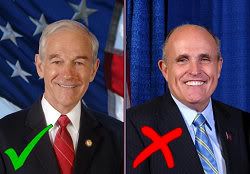 I've seen a number of examples in the past few months of why not to vote for Rudy Giuliani. Shining examples of his lack of knowledge of international issues, foreign policy, our own military history, and even the most fundamental issues regarding the mayorship of his own City.

